Space History News space history and collectibles feature articles
Messages discussion forums about space history and collecting
Sightings calendar of worldwide astronaut appearances
buySPACE marketplace for space artifacts, toys and memorabilia
Resources collecting guides and selected space history documents
Websites related space memorabilia and history websites
|
- The Editor's Collection -
Artifacts space flown equipment and ground support hardware
Autographs who's who in space: the first 25 years of space exploration
Books galleys, drafts, and advanced reading copies
Medallions flown coins and those minted with flown metal
Philatelics first day ceremony programs and flown stamps
|
|
|

The Source for Space History and Artifacts
[ About ] [ Search ] [ Contact ] [ Subscribe ]
|
May 14, 2008 / 1:41 a.m. CT (0641 GMT)
NASA and Velcro: Both NASA and Velcro USA are celebrating their 50th anniversary this year, although it is only a coincidence; contrary to the popular misconception, the hook-and-loop fasteners were not a spinoff from the space program. Trademarked in the U.S. on May 13, 1958, Velcro-brand products have however, played a role in NASA history as the astronaut-preferred means to tether equipment from floating away in space. Red, white, and blue Velcro swatches doubled on-board Moon-bound Apollo missions as both attach points and color-codes for crewman-specific supplies. Velcro is still used today with blue and yellow squares flying on the shuttle and the ISS.
May 11, 2008 / 12:45 p.m. CT (1745 GMT)
Ronald A. Parise (1951-2008): Astronomer turned astronaut Ron Parise, who flew as a payload specialist aboard NASA's only two astronomy-dedicated shuttle missions died May 9 of a brain tumor after fighting cancer for three years. On his first flight in 1990, he became one of the first three astronomers to use a telescope in space and the first to operate packet ham radio, both as a result of payloads that he developed. In total, over the course of STS-35 and 67, he flew over 25 days and 10 million miles.
May 9, 2008 / 12:58 a.m. CT (0558 GMT)
Retired tires to roll out for loan: NASA's new Artifact Loan Opportunities Program, designed to reach "untraditional" audiences through the loan of space-flown hardware, hit the road this week with its first offer of space shuttle main gear tires collected from 50 different missions dating back to 1986. Unlike the agency's earlier artifact loan programs, some of the requirements for the preservation of the tires have been waived to permit their use as art, furniture or building structures. Developed to reach beyond just museums, proposals (due by June 11) will be considered from civic groups, schools, and others.
May 9, 2008 / 12:01 a.m. CT (0501 GMT)
The most wondrous piece of hardware: ABC-TV's "Good Morning America" will be revealing Monday that its panel of experts have selected NASA's Saturn V rocket as one of the '7 Wonders of America'. Built to launch a crew of three astronauts to the Moon in the late 1960s, the 363-foot tall booster will join the ranks of other U.S.-based wonders including the Grand Canyon and the National Mall in Washington, DC. ABC will broadcast live from the U.S. Space & Rocket Center in Alabama, where one of the three remaining Saturn V rockets is on display.
May 2, 2008 / 5:02 p.m. CT (2202 GMT)
Vladimir Gevorkyan (1952-2008): Chosen for the cosmonaut corps in December 1978 Vladimir Gevorkyan, 55, died on April 13 of brain cancer, reports the Russian-language website astronaut.ru. Though he was never to fly, Gevorkyan trained to serve as an engineer onboard the then-secret Almaz military space stations built by the Mashinostroyeniya bureau. He retired from the program in April 1987, and went on to direct the "Terra" science corp.
May 1, 2008 / 1:34 a.m. CT (0634 GMT)
Departure: One of Canada's original space explorers who flew on STS-85 as a payload specialist, Bjarni Tryggvason is retiring this June after nearly 25 years with his nation's space agency. Tryggvason will continue at the University of Western Ontario, where he's presently a visiting professor. Following his first and only spaceflight, he completed training with NASA as a mission specialist, but took a leave of absence to pursue work in the private sector before returning to the Canadian Space Agency in 2004. During his astronaut career, Tryggvason developed vibration isolation mounts for experiments flown on-board the U.S. shuttle, Mir, and the International Space Station.
April 30, 2008 / 1:12 a.m. CT (0612 GMT)
When 'The World Is Not Enough': Many astronauts relate that of all the things they get to do in space, the one they relish the most is looking back at Earth. The space station's portals are the ultimate in picture windows. But when the world is not enough, they have a library of books, movies, tv shows and music to enjoy in their free time. The catalog of titles aboard the ISS was recently released by NASA in response to a Freedom of Information Act request by GovernmentAttic.org. The list includes the predictable (e.g. "The Right Stuff", "Fly Me To The Moon") and the not so predictable (e.g. "Ten-Day MBA", "The Dog Whisperer"). And though "The World Is Not Enough" is not, the astronauts can view "Goldfinger".
April 29, 2008 / 1:58 p.m. CT (1858 GMT)
Dangerous space docs: Dangerous Films, the London, UK-based production company behind the Discovery Channel's NASA 50th anniversary HD mini-series "When We Left Earth" (airing in June), has announced their involvement in two more space history projects. Together with The History Channel, Dangerous is producing "Moon Shot", a docudrama in celebration of the 40th anniversary of the Apollo 11 moon landing in 2009. Dangerous is also filming "Hubble On High", following the STS-125 crew and the final Hubble servicing flight for the Discovery Channel.
April 27, 2008 / 12:14 p.m. CT (1714 GMT)
Launch tower toppled: Six seconds and over 200 pounds of explosives were all that were needed on Sunday to topple what was at one time the largest moving structure in the world. Erected in 1992 to support Titan IV launches, the mobile service tower at Cape Canaveral Air Force Station's Complex 40 may be best known for its role at the start of the Cassini-Huygens mission to Saturn in 1997. In total, the tower prepared 17 Titan IVs and one Titan III (its first launch, lofting the Mars Observer probe), continuing the work of the tower it replaced, which was in service since 1965. As the Titan IV retired from service in 2005, the tower was no longer needed and was toppled to clear way for SpaceX to use the complex for its Falcon 9.
April 25, 2008 / 7:53 p.m. CT (0053 GMT Apr 26)
Space Shuttle wing: Since 2001, the U.S. Astronaut Hall of Fame has been honoring the men and women who have flown on the space shuttle, adding them to the ranks of Mercury, Gemini and Apollo veterans. The Hall, which is located in Florida near the Kennedy Space Center, bills itself as having "the world's largest collection of personal astronaut memorabilia," but until now, mostly featured artifacts from the pre-shuttle programs. With the next four astronauts scheduled to be enshrined on May 3, their mementos will join those from the 22 previous fliers within the Hall's new orbiter-themed wing. "Space Shuttle: The Astronaut Experiences" opening May 2, promises to celebrate the "talents, courage and accomplishments" of the Hall of Famers from the soon to be ending shuttle-era.
April 23, 2008 / 1:05 p.m. CT (1805 GMT)
Space station sakura: On Tuesday, JAXA approved a project to launch seeds from 10 cherry trees, including three designated as national treasures, to their laboratory on the International Space Station. Flying with lily and violet seeds, the 'sakura' (cherry tree) pips are slated for liftoff with the STS-126 mission onboard space shuttle Endeavour this October. Children will collect fallen seeds this summer for the trip. After the flight, the seeds will be shared with scientists to study the effects of microgravity.
April 22, 2008 / 4:37 p.m. CT (2137 GMT)
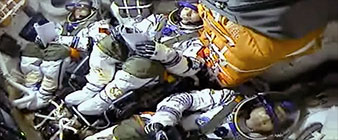
Shadows of Soyuz 5: Soyuz TMA-11's off course landing may have been the result of more than just a ballistic mode reentry. The crew reported a jostling after the command was executed for the craft's service module to separate from the descent module, in which they were seated. The motion, which they deemed off-nominal, may have indicated a detachment failure, which may have put the spacecraft in a nose- or hatch-down orientation, rather than the normal heatshield-facing direction. Sources cited by Russian reports suggested that the greater heating led to damage to the capsule, including a communication cut- off linking the cosmonauts with the ground. NASA said on Tuesday that it was too early to speculate, but confirmed that Soyuz TMA-10, the previous Soyuz to land, was met with a separation issue. If indeed the two modules did not separate until aerodynamic stresses broke them free, the scenario would be an echo of the 1969 reentry of Soyuz 5 and its sole crew member Boris Volynov, who nearly died.
[ browse earlier updates ]
|
To join our mailing list, send an e-mail to: subscribe@collectspace.com with the subject line "collectSPACE Update"
© 1999-2008 collectSPACE.com All rights reserved
|
|
|
|