 posted 10-16-2026 11:37 PM    
I don’t have the information or knowledge to be able to specifically answer the question about Apollo 13 using the lunar module engines capability to carry out a trans-Earth injection (TEI) LM engine manoeuvre from an established lunar orbit, but it does appear it was considered with regard to failure of the service propulsion system (SPS) which is essentially what Apollo 13 faced in regard to the capability of the damaged service module.After Apollo 13, NASA conducted a search and review of earlier considerations of using the lunar module as a "lifeboat." I have a copy of a document from the UH-Clear Lake (Lunar Excursion Module Propulsion Systems As Backup to The Service Propulsion System – Nov 1963) that examined the possibility of using the LM engines. 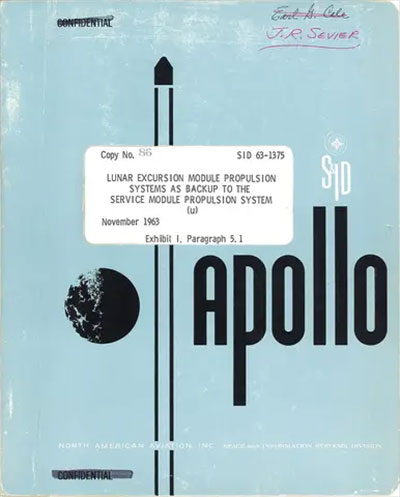 ...and from some Don Puddy's files, that indicate right from the beginning of Apollo moon mission planning, the use of the lunar module propulsion systems was considered although not for the specific case encountered by Apollo 13.
In particular, the case of a SPS failure requiring the lunar module engines was considered for some scenarios including while in lunar orbit but prior to descent. A memo of 23 October, 1964 by John Mayer cites this scenario from a presentation to the Action Committee Meeting of 15 July 1963 but considered it "a very rare case." A description in Apollo 13 – Lunar Trajectory Notes - April 8, 1970, states on page 88, Lunar Phase AbortsOnce the spacecraft begins the lunar orbit insertion (LOI) burn, it is no longer on a trajectory that will return it to earth. For the spacecraft to leave lunar orbit, the velocity of the spacecraft must be increased so the space craft can escape the gravitational pull of the moon. Normally, this acceleration is obtained by using the service propulsion system (SPS) engine in the service module. However, techniques have been developed so that the LM descent engine can return the spacecraft to earth. These techniques could be used if the SPS engine fails during the LOI burn which is the first large burn of the engine. The abort procedures are of three modes which are illustrated in figures 10, 11, and 12. Based on the length of the LOI burn, one of the three modes can be used to leave lunar orbit. 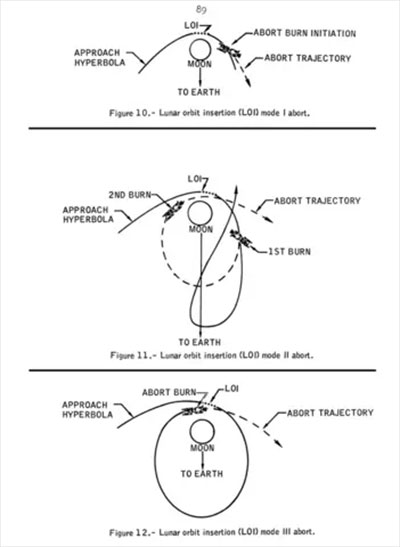 Another NASA document, available on the NTRS – NASA-TM-X-1806, “Translunar Abort Techniques For Non Free-Return Missions” also explores a similar situation and further states that it requires jettisoning of the service module. Very early studies had also considered jettisoning the descent stage after depletion of propellants and using the ascent engine, but this was later ruled out as the lunar module ascent propulsion system (APS) did not have sufficient control capabilities when attached to the command and service module. | 







 advertisement