|
|

|
|
Author
|
Topic: Apollo-era wide-angle Fairchild/Maurer lens
|
Space Junk Punk
Member Posts: 78
From: Atlanta, GA, USA
Registered: Jul 2021
|
 posted 06-11-2026 12:26 AM
   
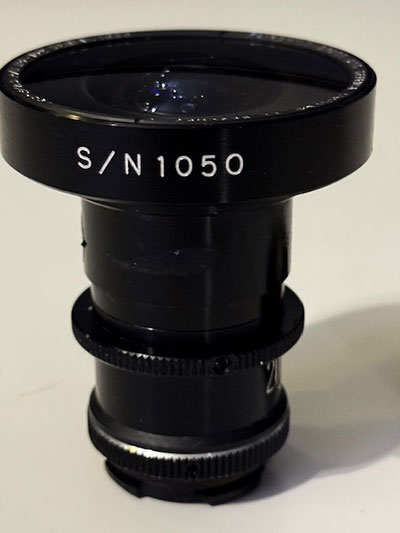
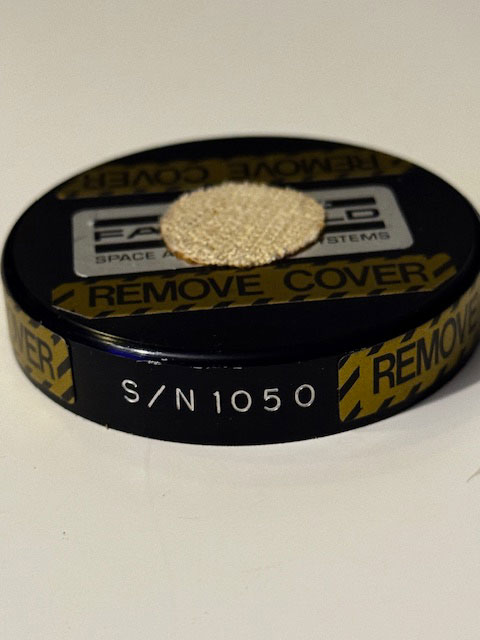
I just acquired this lens by Fairchild Space Defense Company. I believe it's associated with the Data Acquisition Camera (DAC) used on Apollo. Can't find anything that ties the serial number on this unit. Was curious if any Apollo experts here could give me any info on this actual lens, or what the "207" in the part number is referring to? P/N 110-102, SEB 33100056-207, S/N 1050. It has a lens cap with aged white velcro. Came from Johnson Space Center. 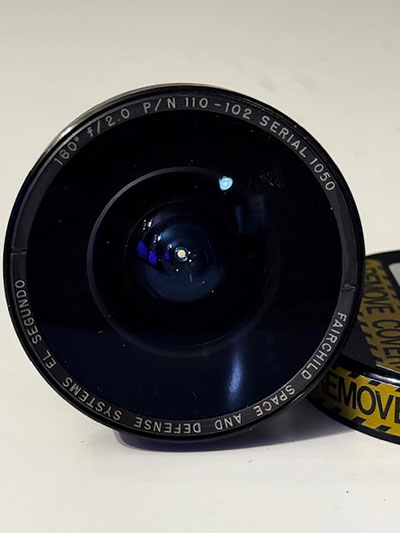 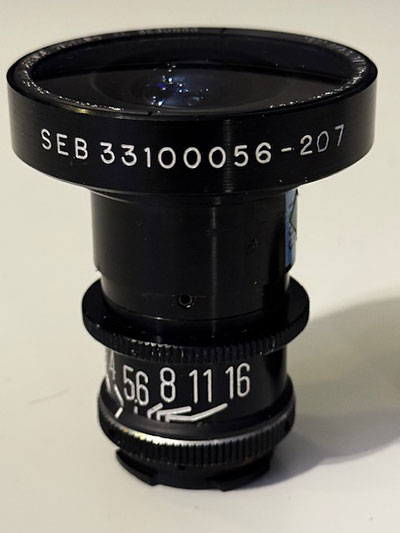
|
rgarner
Member Posts: 1516
From: London, United Kingdom
Registered: Mar 2012
|
posted 06-11-2026 07:03 AM
It could be the 5mm lens from the DAC. The Smithsonian has one here. |
Space Junk Punk
Member Posts: 78
From: Atlanta, GA, USA
Registered: Jul 2021
|
posted 06-11-2026 09:38 AM
AI says it was a DAC lens, and it's very close to a perfect match to the one in the Smithsonian. Ghe only difference being that the aperture numbers are inverted between the 2. In the "Apollo Handbook of Pilot Operational Equipment For Manned Space Flight" there is a picture of this lens with the same orientation of the aperture numbers. It also refers to the one for Apollo has P/N configuration number of 208, which is "Apollo and Skylab Flight Unit." This one has a configuration of "207," which I want to find out what that configuration is for. Either way it seems like a hard to find lens used by the DAC camera. |
Space Junk Punk
Member Posts: 78
From: Atlanta, GA, USA
Registered: Jul 2021
|
posted 06-18-2026 04:48 AM
After hours of research I know that this lens is nearly identical to the flown Apollo lens at the Smithsonian. The difference is the variant — the one I have is 207 while 208 is Apollo Skylab Flight ready ones like the Smithsonian's. I know the mount is the same custom bayonet style that the DAC camera uses, so I am curious if this lens can actually be from Gemini or pre-Apollo? The DAC was flown on Gemini I believe, but haven't seen any info linking that program to the 207 variant. Otherwise I'll probably assume 207 means flight qualification unit? Someone also told me this model lens was the same one they used to create HAL in 2001 a Space Odyssey... interesting. |
oly
Member Posts: 1569
From: Perth, Western Australia
Registered: Apr 2015
|
posted 06-18-2026 07:34 AM
The infamous HAL 9000 was built around a Nikkor 8mm f/8 Fisheye Lens.The lens used to film from HAL's perspective was a Fairchild-Curtis 160-degree wide-angle lens. |
Space Junk Punk
Member Posts: 78
From: Atlanta, GA, USA
Registered: Jul 2021
|
posted 06-18-2026 08:06 AM
Ah, thanks for the clarification, the lens here is a 160 deg Fairchild Maurer lens, so maybe similar to the Curtis variant. |
SpaceAholic
Member Posts: 5585
From: Sierra Vista, Arizona
Registered: Nov 1999
|
posted 06-18-2026 09:42 AM
160 deg HAL Shoot (massive lens). |
oly
Member Posts: 1569
From: Perth, Western Australia
Registered: Apr 2015
|
posted 06-18-2026 09:39 PM
The Apollo Maurer 16mm data acquisition camera (DAC) used 16mm film stock; the Fairchild-Curtis 160-degree ƒ/2 ultra wide-angle lens had the ability to cover an image area large enough for 70mm film. It is a significantly larger lens. Kubrick paired the Fairchild-Curtis 160° with a 65mm Super Panavision camera to capture HAL's unique perspective.The lens was originally developed in the late 1950s and early 1960s by Felix L. Bednarz for Fairchild and Cinerama. The lens was designed to simulate human peripheral vision and project large-format imagery onto dome screens. Because Kubrick projected the image onto flat film, the image gave a distorted perspective. Details of the 5mm Fairchild-Curtis 160-degree ƒ/2 ultra wide-angle lens can be found on page 33, of this Handbook of Pilot Operational Equipment for Manned Space Flight from 1972. This document details that the -208 designation was for the Apollo and Skylab Flight Unit, and was predominantly designed for interior shots using the DAC. |
SpaceAholic
Member Posts: 5585
From: Sierra Vista, Arizona
Registered: Nov 1999
|
posted 06-18-2026 11:21 PM
Fairchild Space and Defense 5mm (in the Pilot Operational Handbook) did you intend to say?Rumor has it the Fairchild Curtis lens helped spawn IMAX. |
Space Junk Punk
Member Posts: 78
From: Atlanta, GA, USA
Registered: Jul 2021
|
posted 06-20-2026 05:33 AM
I think the Fairchild Curtis lens is different than this one. The document you sent is a really good resource for Apollo cameras and equipment used, but since it is from 1973, I think it is a cumulative list of all the photo gear in general., There is another similar NASA technical paper that has a complete chart of all photographic equipment and application separated by missions, all the way to Mercury 6: Apollo Experience Report Photographic Equipment and Operations During Manned Space Flight Programs. The Fairchild Curtis lens was different from the Fairchild Space and Defense lens, similar specs, but the latter was all black and had a custom mounting that only fit the NASA DAC system, a bayonette type mount. |
oly
Member Posts: 1569
From: Perth, Western Australia
Registered: Apr 2015
|
posted 06-20-2026 09:24 AM
quote:
Originally posted by Space Junk Punk:
I think the Fairchild Curtis lens is different than this one.
Page 33 (2.5-1) lists the same SEB3300056 part number for the 5mm lens, however, yours has the 207 configuration number and that document details the 208 configuration.That same document details that the 5mm lens, part number SEB3300056, was manufactured by Fairchild Space Defense Systems, with the same markings as your lens. Both are 160 degree, f/2 minimum aperture lenses, same part number, different configuration. The one detailed in that document is the 5mm lens for the DAC. The JSC part number format had a - (dash) suffix configuration number. Without knowing how the system worked (anyone know the configuration manager?) I would assume that the difference between a -207 lens and a -208 lens was a small design or manufacturing change, which in this case, may be the re-orientation of the f-stop numbering, which may have come about via feedback from crew stating that the thought the numbers were hard to read and needed re-orientation, or some completely different reason. Given that the Apollo 11 lens is serial number 1018, and yours is 1050, and the image in that document shows a -208 lens with the f-stop numbers orientated the same as yours, i doubt that changing the f-stop numbering was the reason for the configuration change. The Apollo 8 and 9 DAC at the National Air and Space Museum has a -206 configuration 5mm lens. Perhaps a flight manifest has the -207 configuration lens listed somewhere. |
Space Junk Punk
Member Posts: 78
From: Atlanta, GA, USA
Registered: Jul 2021
|
posted 06-20-2026 12:47 PM
I'm aware of the 207-208 variants, that's the main question I would like to know, what the 207 stood for. I'm not looking for proof this was flown or anything, I just would like to know it's history. I've read all the Apollo missions' stowage manifests and a DAC camera and a 5mm lens were listed as stowage on Apollo 8, 9, 10, 11, and 12. In Apollo 8 and 9 the 5mm lens has another variant listed -206, then the other later missions are 208. I'm thinking 207 must've been a few units between missions that something was changed, and then changed again to go up to -208. |
oly
Member Posts: 1569
From: Perth, Western Australia
Registered: Apr 2015
|
posted 06-20-2026 09:29 PM
Do images exist of the DAC in use with a 5mm lens inside the Apollo or Skylab command module or lunar module, and is any footage taken by the DAC using the 5mm available that has a record of equipment used? |
Space Junk Punk
Member Posts: 78
From: Atlanta, GA, USA
Registered: Jul 2021
|
posted 06-22-2026 02:35 AM
I've found 16mm DAC onboard footage from Apollo 7, 8 , 9, 10, 11, 12 on the Internet Archive. There also is an index of all the Apollo 11 images taken in 70mm and 16mm but mainly to help plot locations for mapping, so not sure if it includes interior shots.The Smithsonian has complete stowage manifests for all the Apollo missions and list the DAC and Fairchild 5mm lens as stowage for Apollo 8, 9, 10, 11, 12. There was some GSE used for electronically testing all the Apollo cameras and lenses before flights, I'm wondering if this one, -207 was maybe allocated for GSE testing? I also wonder if the serial numbers were in order of production, i.e. was SN-1050 the 1,050th unit to be made? |
oly
Member Posts: 1569
From: Perth, Western Australia
Registered: Apr 2015
|
posted 06-22-2026 05:47 AM
Your lens has both the manufacturer's part number, 110-102, and the JSC drawing number, SEB 33100056-207. The serial number S/N 1050. is also on both the front of the lens and the side.Usually, serial numbers are issued sequentially by the same configuration manager or department that allocates the configuration number. The configuration department can be thought of as the people responsible for controlling the engineering drawings and making sure that older drawings are withdrawn from use and new drawings are issued. It is also generally where part numbers are generated or issued when a change is needed. Where you have a large project consisting of engineers designing things, draftspeople producing drawings, technicians discovering that part A does not fit into slot B as designed, so a change is required to a drawing or specification, the configuration department is responsible for managing that change. Fairchild Space Defense Systems, or someone who worked and was familiar with this company, may be aware of the development of these lenses and the configuration changes made to them. A config change could be something as simple as changing the typeface of the engraving, changing a material spec, change of supplier of a part or component, discovering a design defect that required a design change where it was essential that a new item can be easily identifiable over the defective design, etc. The configuration number could also be interpreted differently by different manufacturers. 207 could mean configuration number 207, or 2-07, or 20-7 etc. It could be the 7th iteration of design number 20, the 20th iteration of design number 7, the 207th design change, or even component number 207 on a different engineering drawing. However, the light at the end of the tunnel is that you are aware of a 206 and a 208 version of the same 5mm DAC lens. This probably means that there was a configuration change made after Apollo 8 and 9 and before Skylab. One change you have identified is the orientation of the f-stop numbers. Perhaps a change was made because post-flight feedback found that the users felt the numbers were upside down, a change was made, and the drawings, specifications, and manufacturing instructions were updated to a new configuration. It also may have nothing to do with it. The Skylab era document identifies that configuration 208 was certified for use in Skylab. I suspect that your best chance to narrow the search is to find earlier documents that detail configurations 206 and 207 as certified for use as a way to identify when these changes happened and if 207 was ever certified for use. The DAC system was used in other arenas as an engineering camera. Perhaps your lens was one of these. |
Space Junk Punk
Member Posts: 78
From: Atlanta, GA, USA
Registered: Jul 2021
|
posted 06-22-2026 05:36 PM
Wow thanks for putting your time into passing on that great information. You've helped shed some light on the history of this lens, and given me a thought to consider. I do believe in addition to you've already noted, this model lens could possibly have been used towards the tale end of Gemini, which I think I read is when the DAC started being implemented or tested. Thanks again for your input Oly! |
space1
Member Posts: 977
From: Danville, Ohio
Registered: Dec 2002
|
posted 06-23-2026 08:19 PM
I finally located my Gemini Spacecraft No 12 Stowage List. It lists a quantity of two of "Part Number CF55060-2 16mm camera, 5 mm lens assy." So this very different part number appears to rule out your lens for Gemini 12 and presumably other Gemini missions. I don't have this drawing, but other CF assembly drawings list CF part numbers for the lens and other items making up the assembly. Most of the photo (and other) equipment listed has this type of CF number. |
oly
Member Posts: 1569
From: Perth, Western Australia
Registered: Apr 2015
|
posted 06-25-2026 05:00 AM
It would be interesting to see if the Gemini documents identify the lens manufacturer for the Project Gemini 5mm lens.Also, the SEB part number format was developed by JSC for the Apollo program, and could possibly be the CF part numbers changed to the SEB format. It seems that there were several lens manufacturers who made lenses for the Gemini, Apollo, Skylab, and early Shuttle Data Acquisition Cameras. Just because the Gemini lens appears to have different part numbers does not mean these were the same lenses sourced for Apollo, Skylab, or early Shuttle missions, or other DAC uses. This thread about the Maurer Data Acquisition Camera details some different models of the DAC and some different lenses, as well as an active link to an Italian web page about Kern Lenses. This thread details information about the Apollo Maurer 16mm right angle mirror. |
Space Junk Punk
Member Posts: 78
From: Atlanta, GA, USA
Registered: Jul 2021
|
posted 06-26-2026 07:10 AM
Yea Scott's (SpaceAholic's) DAC collection is impressive... it's interesting though that thread is mostly about what little information there is on the DAC assembly, and how hard it is to find the 5mm Fairchild lens. Let me comment on the NASA part number and catalog system... my biggest wish would be for someone to publish a book explaining the methodology and create a central database for the everything, because it's a new mystery every time I research something I haven't seen, basically goes down a rabbit hole never to be seen. Like the Gemini stowage list John (space1) mentioned, but it's the same for most of the Apollo ones too. They list the DAC part number, then list lenses by mm size... that is the issue, it's hard to find out which exact lenses of several varieties were flown by part numbers and variants. One thing that helps is the DAC did have a custom lens mount design that this 5mm lens has, so it would only be used for a DAC. The question is which one? On edit: One thing I noticed in the Smithsonian 5mm lenses is the -206 or 208 variant is hand written over the engraved part. |
oly
Member Posts: 1569
From: Perth, Western Australia
Registered: Apr 2015
|
posted 06-27-2026 01:53 AM
quote:
Originally posted by Space Junk Punk:
my biggest wish would be for someone to publish a book...
That would be a big book.Part numbering systems almost always end up being a mess. Years ago, the Air Transport Association of America (ATA) came up with a standardised numbering system for aircraft, where each chapter was allocated to a specific system and zone. For example, ATA 100 Chapter 32 covers Landing Gear, Wheels, and Brakes. This was a great idea because the manuals could be written in a standardised way, where whichever pilot training documents you picked up, chapter 32 covered the landing gear system. Maintenance manuals and parts catalogues were the same. Some manufacturers even adopted this system into their numeric part number system, where a part number that started with 32 was a landing gear part. Engineering drawings incorporated the same idea. Ideally, the first part number for a landing gear component would be 32-1, the second would be 32-2, etc. A standardised format was that left-hand parts used odd numbers and right-hand items used even numbers, so the left-hand item could be 32-1 and the right-hand items 32-2. However, aircraft can be a complicated mix of parts which use approved nuts, bolts, screws, washers, seals, gaskets, etc, and aircraft manufacturers tend to use standardised, approved parts where possible because going through the approval process for every nut, bolt, screw, washer, and rivet becomes very expensive very quickly, and takes a long time. Either manufactures allocated their own part number to an existing part made by someone else, so a standard AN3 bolt got a 32-3 part number, or the parts system now has more than one part numbering sequence, a mix of AN3 and 32-3 numbers. Add to the mix, aircraft manufacturers do not normally make engines, and engine manufacturers have their own part numbering systems, and also use standardised hardware where possible. They also do not generally make avionics, instruments, or even seats and fire extinguishers. If an aircraft manufacturer makes more than one type of aircraft, the needed an unique identifier to indicate the difference between landing gear component number 1 (32-1) for type A aircraft, and landing gear component number 1 (32-1) for type B aircraft. So the identifier went at the front of the part number 123-32-1 versus 124-32-1. The sub-systems also need a way to identify their part numbers. So a left-hand landing gear strut may have a 123-32-01-1 part number, the wheel assembly may be 123-32-02-1, and the brake assembly may be 123-32-01-2. But aircraft generally have 3 or more wheels, and also have a left hand, a right hand, and a nose or tail wheel. Now imagine if component A has a design change where a major sub-component has to be totally redesigned, and you need to be able to differentiate between the old version and the new and improved version. Or if a parts manufacturer goes out of business, or changes the vendor for the material that they make their parts from. Because NASA was a government organisation that mostly had hardware, parts, components, and vehicles built by contractors, The JSC numbering system got very messy, very quickly. quote:
They list the DAC part number, then list lenses by mm size...
Using a camera requires an understanding of which lens to use as well as the various settings for exposure. Generally, lenses are identified by their focal length in mm and their fastest aperture by f/stop.During training, the crew was probably trained to think about the lens needed for a particular use, or in the case of the data camera inside the command module, making sure to use the 5mm lens, so the vernacular and phraseology during training would reference focal length in mm. for each lens. It would be easier to write procedures and checklists referencing the same information used during training, so I guess a reference using mm versus a configuration number was preferred or easier. They could just as well have color-coded each lens and referred to the specific color in the checklist, etc. Using a reference in focal length in mm crosses over to the 35mm camera as well as the 70mm camera, and the crews would have used this format during their photography training and field trips. |
SpaceAholic
Member Posts: 5585
From: Sierra Vista, Arizona
Registered: Nov 1999
|
posted 07-24-2026 11:15 AM
quote:
Originally posted by rgarner:
The Smithsonian has one here
A couple of irregularities have increased my index of suspicion the lens captured in the National Air and Space Museum's image may be misattributed to Apollo 11. Focal ring text is inverted with respect to the -207 variant discussed by the OP; and the lens cover does not appear to have been prepared for flight (from what is visible in the singular NASM image, do not see indication decals were applied which were characteristic of the flight article). Curious to know what drawing variant suffix is inscribed on the museum's lens and cap (is it indeed the -208 variant that was documented within the Apollo 11 ASL to have been manifested)? An additional data point of comparison exists as well within the previously referenced equipment handbook. The example imaged in the handbook does show a known -208 suffix 5mm lens; the focal ring text is oriented opposite the Smithsonian example (but consistent with the -207), and the lens cap has the correct decals for flight application. |
CJ
Member Posts: 115
From: Cherry Hill, NJ
Registered: Nov 2003
|
posted 07-24-2026 08:58 PM
An AI search came up with this... VariationsThe suffix changes depending on the exact mission configuration and flight readiness level: - -201 / -202: Early Apollo test flights (such as Apollo 7).
- -206 / -208: Standard flight configurations used on the lunar surface and command modules for iconic missions like Apollo 11, Apollo 12, and Apollo 14.
- -207: Specifically designates an official NASA-contracted engineering configuration variant of this Fairchild/Maurer wide-angle optical assembly.
|
SpaceAholic
Member Posts: 5585
From: Sierra Vista, Arizona
Registered: Nov 1999
|
posted 07-24-2026 10:06 PM
All engineering variants were NASA contracted not just the 207, and correcting the AI search (-205: Apollo 7, -206: Apollo 8-10, -208: Apollo 11-13)Following this morning's post received a note from another collector who retains examples of the 205, 206, 208 and 209 Fairchild lens variants and he confirmed the 205/206 both have text that must be read while forward facing the lens; the 208 and 209 have ring text that are read rear facing. With the 207 that has emerged this thread its apparent the ring text orientation transitioned from -206 to -207 further reinforcing my belief the lens featured in the NASM entry was not Apollo 11 flown. Disposition of the actual 5mm lens flown on Columbia might be elsewhere in the national collection, or if not circulating in the "wild"? | |
Contact Us | The Source for Space History & Artifacts
Copyright collectSPACE. All rights reserved.

Ultimate Bulletin Board 5.47a
|
|
|
 advertisement advertisement
|